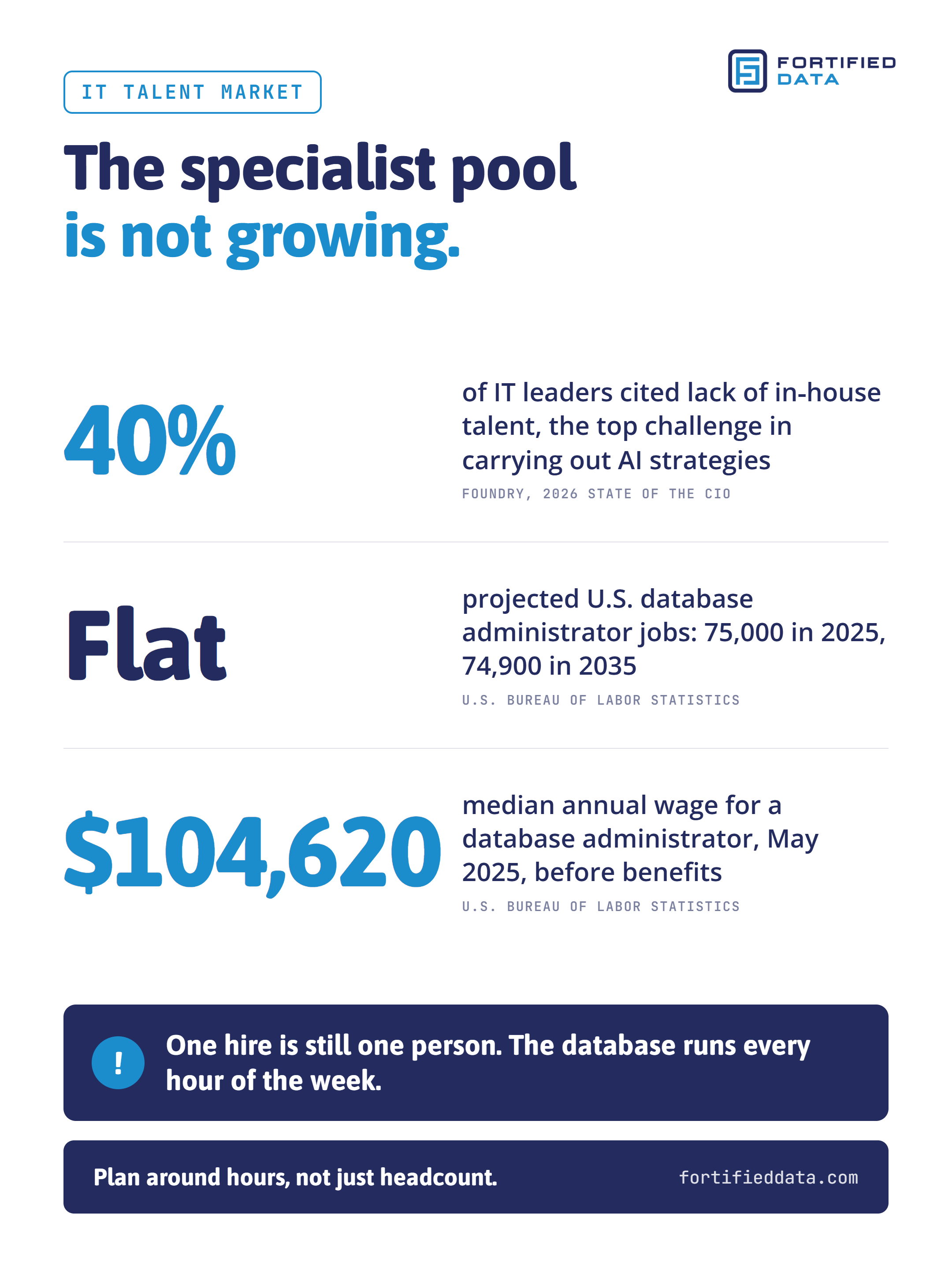
In Foundry's 2026 State of the CIO survey, lack of in-house talent was the top challenge in carrying out AI strategies over the past year, cited by 40% of IT leaders. That reads like a hiring problem. In practice, it is often a time problem. The people who could do the strategic work are spending their week keeping systems running, and the database is one of the largest claims on that week.
The case for outsourcing database administration is usually made on coverage and cost. This post makes it on strategic capacity: what your team could build if the database stopped claiming its time, and how to tell whether the hours came back. Here are six questions to work through.
How much of your IT team's week goes to keeping databases running?
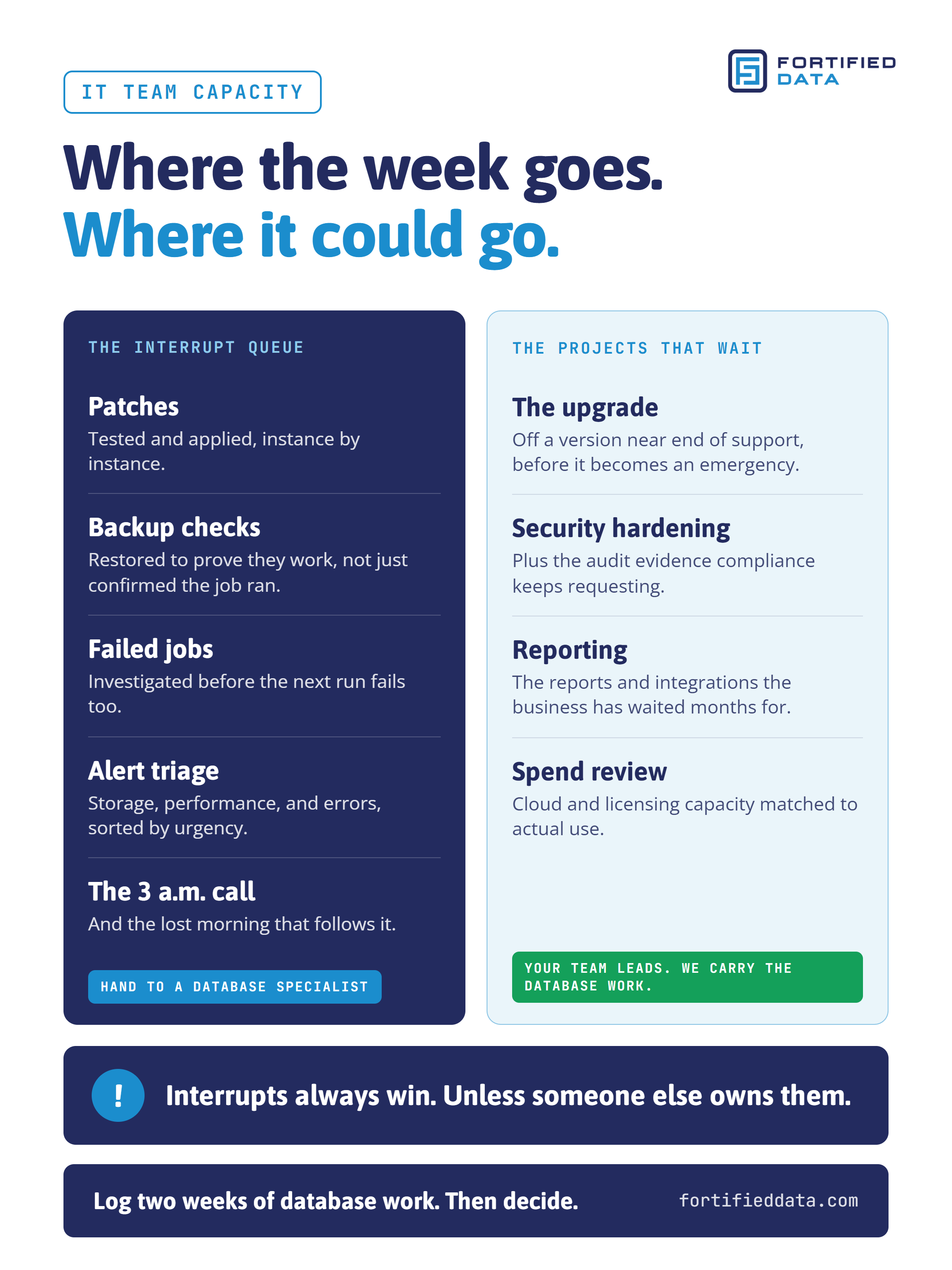
In a company running 3 to 25 SQL Server instances without a dedicated DBA, database work does not disappear. It lands on whoever is closest: an infrastructure engineer, a systems administrator, or the developer who knows the application best. Patches need testing and applying. Backups need verifying, which means restoring them, not just confirming the job ran. Failed jobs need investigating, alerts need triage, and storage needs watching before it runs out.
None of this appears on a project plan, so it rarely gets measured. It arrives as interruptions spread across several people, which is why leaders underestimate it. McKinsey described one large European bank that was spending 70% of its IT capacity maintaining legacy systems. Your number will be different. The point is that most organizations do not know theirs.
The fix is to measure it. Log every hour spent on database upkeep for two weeks, by person, including after-hours time. That turns a vague sense of being busy into a number you can plan against.
A simple illustration shows why the number matters. If three people each spend six hours a week on database upkeep, that is 18 hours a week, or roughly 900 hours a year. That is close to half of one full-time engineer, spread across three people who were hired to do something else.
Why does database work crowd out strategic projects?
Interrupt work always wins. When a nightly job fails or a disk fills at 3 a.m., the project scheduled for that morning waits. That is the right call in the moment, but it repeats. A modernization project planned for one quarter slips into the next, not because anyone deprioritized it, but because the database kept asking first.
The after-hours call has a second cost. The engineer who spent two hours on an overnight incident is not doing focused project work the next morning. Across a year, those lost mornings add up to the projects that never ship.
Hiring a dedicated DBA is the obvious fix, and for some organizations it is the right one. The specialist pool is not growing, though. The U.S. Bureau of Labor Statistics projects employment of database administrators to stay flat, from 75,000 in 2025 to 74,900 in 2035. The median annual wage was $104,620 in May 2025, before benefits. One hire also brings its own coverage gap, because one person cannot cover every hour of the week. For the full staffing math, see in-house vs. managed service provider.
Fortified Data's dedicated after-hours team works a scheduled shift rather than waiting on call, so the engineer is already working when an issue comes in. Fortified Data covers 24/7 x 365 with a 100% U.S.-based team. Every person who touches your environment, including any subcontractor, is based in the U.S., with no hand-off to an offshore team. Your internal staff are no longer the first call at 3 a.m. for a database issue.
What could your team build with that capacity back?
Strategic capacity is the share of your team's hours spent moving the business forward instead of holding it in place. In most IT departments, the list of what to do with it already exists: the backlog leadership approved and the team has not reached.
In practice, that backlog tends to hold the same few projects. Upgrading off a version near end of support before it becomes an emergency. Hardening security and building the audit evidence your compliance team keeps requesting. Delivering the reporting and integrations the business has waited months for. Reviewing cloud and licensing spend so capacity matches actual use. Increasingly, it also holds the AI initiatives from the opening statistic, and those depend on clean, well-governed data and a database tier that can carry the load.
Each of these needs people who know the business and its applications, and that knowledge sits with your internal team. Your team should own the priorities, the decisions, and the relationship with the business. The database-heavy parts of these projects are different, and Fortified Data can carry them alongside your team. Upgrades and migrations run through a contracted block of on-demand hours, available at every tier. For Select and Signature clients, data security reviews are part of the Strategic Improvement Plan. Reporting, integration, licensing, and AI readiness work run as a scoped consulting project or assessment. Your team leads, and our specialists do the database work.
An hour your engineer spends verifying a backup is an hour not spent on work only your team can do. The goal is to free up IT team capacity for that work, not to make the team smaller.
What should outsourcing database administration cover, and what stays in-house?
Outsourcing database administration works best with a clear line between the two sides. The run work goes to the specialist: monitoring, patching, backup and restore verification, performance and capacity checks, incident response, and after-hours coverage. Your internal team keeps what depends on business context: application ownership, priorities, change approval, and the relationship with the people who use the data.
A written split prevents two failure modes: duplication, where your team rechecks work the provider already does, and gaps, where each side assumes the other owns a task. Agree on it before go-live, with a name on each side.
Fortified Data completes structured onboarding before go-live. Architecture, server health, configuration, capacity, and disaster recovery readiness are reviewed, and agreed performance goals and monitoring baselines are documented. Each managed services client is then assigned to a POD, a dedicated DBA team that shares documentation and knowledge of the environment, supported by a Strategic Account Manager.
Many smaller companies already rely on an MSP for infrastructure, and that model works well when a database specialist delivers the database layer. Fortified Data supports clients directly and through MSP and technology partners. In a partner engagement, the partner owns the broader relationship and its infrastructure, application, or security services, while Fortified Data delivers the database work. Clients get the full breadth of their MSP with the depth of a database specialist.
What are the benefits of managed DBA services in business terms?
The benefits of managed DBA services should show up in outcomes leadership already tracks, not in ticket counts. Four matter most:
- Cost control: predictable spend for less than the fully loaded cost of recruiting and retaining a team to provide the same coverage.
- Cost avoidance: outages that never happen and emergency projects that never get staffed, because problems are caught before users notice them.
- Security and stability: a patched, hardened, consistently configured environment, with audit-ready evidence for compliance.
- Performance that scales: capacity planning and tuning that keep pace with growth in data volume, users, and transactions.
A fifth outcome matters over time: continuous optimization, where month twelve is measurably better than month one, with faster queries, fewer recurring alerts, and a documented roadmap. For your team, the measure is simpler: the hours you get back turn into delivered projects.
If a provider cannot show you these outcomes from current clients, the dashboard is all you are buying.
How do you know the capacity actually came back?
Repeat the two-week log six months after go-live. Then track three numbers leadership already cares about: internal after-hours pages for database issues, approved projects delivered on schedule, and hours your engineers spend on roadmap work. If those numbers do not move, the handoff is incomplete, and the ownership split needs another look.
Watch the provider's side as well. A provider that only keeps the environment stable leaves the improvement work with your team. For Select and Signature clients after go-live, Fortified Data's Strategic Improvement Plan covers index strategy, performance, capacity, and data security. Each review cycle, the team remediates the highest-impact condition identified through telemetry and that plan, so account reviews track completed improvements, not just system status.
Six questions to take into your next capacity review
Before the next budget or headcount decision, take these questions to your team and to any provider you are considering:
- How much of our week goes to keeping databases running, and whose week is it?
- How much of our slipped project work traces to database interruptions and after-hours calls?
- What would we build with that capacity back, and which approved projects are waiting?
- What should outsourcing cover, what stays with us, and who actually delivers the database work?
- Which business outcomes can the provider show from a current client like us?
- Six months after go-live, how will we know the capacity actually came back?
Outsourcing database administration puts your team's hours where only they can put them. Start with the two-week log. If you want help running it, a Fortified Data specialist will map the database work your team carries today and show where the hours go. They will also outline what would move to us and what stays with you. To get started, talk with our team.
Not ready for a conversation? Take our free Database Health Score. It takes about five minutes and requires no access to your systems.
Sources
- Foundry, 2026 State of the CIO
- CIO.com, "What's holding back enterprise AI? Shortage of talent, CIOs say," April 30, 2026
- McKinsey, "AI for IT modernization: Faster, cheaper, better," December 2, 2024
- U.S. Bureau of Labor Statistics, Occupational Outlook Handbook, Database Administrators and Architects