Forty-three percent of respondents in Whitelane Research's 2026 UK and Ireland IT Sourcing Study said their service providers do not challenge them enough. It was the most frequently cited provider weakness across more than 1,000 sourcing relationships. I read that number as a verdict on the review meeting. A strategic improvement plan review is the one hour each cycle where a provider is supposed to challenge you. In most engagements, it has turned into a status readout.
Consider what that hour costs. Put a CFO, a CIO, and a Director of Data at the table, and the meeting takes three hours of leadership time from the people who own the budget and the risk. That time should produce decisions. Below are six questions that sort what earns a place on the agenda from what does not.
Why do so many database reviews end with nothing to decide?
A typical review agenda looks familiar. Uptime above 99.9%. Ticket counts by severity. A list of patches applied. A line that says "no major incidents this period." Every item is true, and every item looks backward.
Nothing on that agenda asks leadership to decide anything, so leadership stops attending. The review becomes a conversation between two technical teams. The budget conversation then happens somewhere else, months later, without the evidence the review should have produced. I made a version of this point in my September post on how to vet a managed database services provider: an uptime report confirms nothing broke, not that anything improved.
Buyers have already moved past the status model. Deloitte's 2024 Global Outsourcing Survey found that reported adoption of new outcome-based strategies rose from 45% to 67% of respondents in two years. If you are paying for outcomes, the review is where the outcomes should be shown.
What should a strategic improvement plan review open with?
It should open with last cycle's commitments. Each one is listed, marked done or not done, and backed by evidence. System status comes after that, briefly. The first ten minutes decide what the meeting is about, so give them to the commitments.
Commitments only mean something against a starting point. "Faster" and "more stable" need a number that was written down before the work began. Without one, every review is a fresh impression rather than a measurement.
This is why onboarding matters more than most buyers expect. Fortified Data completes structured onboarding before go-live. Architecture, server health, configuration, capacity, and disaster recovery readiness are reviewed, and agreed performance goals and monitoring baselines are documented. Every later review measures against that document.
What does a completed improvement look like on paper?
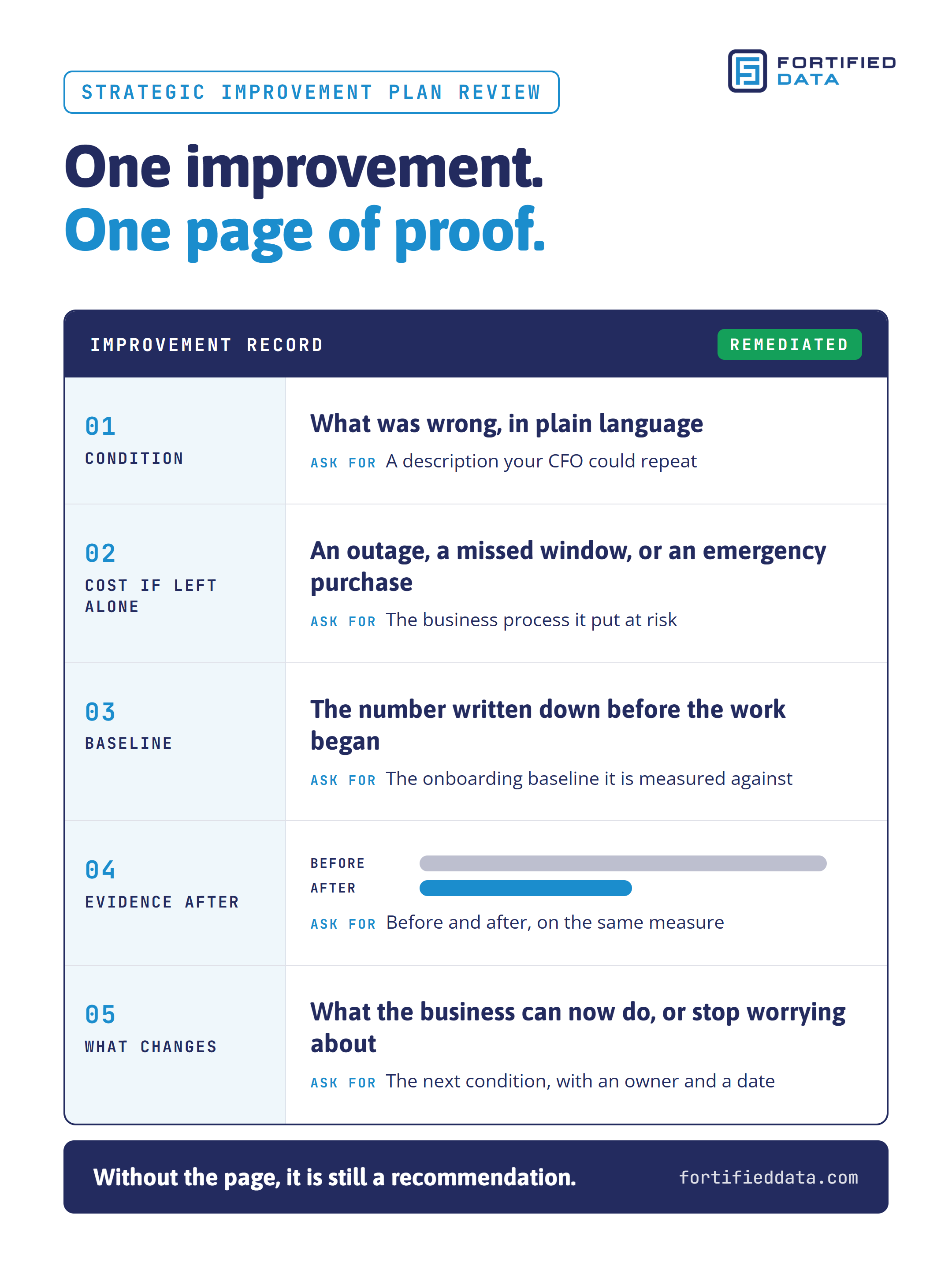
A completed improvement fits on one page. It names the condition in plain language. It states what the condition would have cost the business if left alone. It shows the evidence before and after, measured against the baseline. It ends with what changes for the business now.
Here is the shape of one, as an example. A month-end reporting job had been running longer each month as data grew, and the trend showed it would soon miss its window. The team found the cause, removed it, and attached run times from before and after. Finance closes on schedule, and nobody had to approve an emergency hardware purchase to get there.
That is the standard our Strategic Improvement Plan is built to meet. After go-live, Select and Signature clients receive a Strategic Improvement Plan covering index strategy, performance, capacity, and data security. Each review cycle, the team remediates the highest-impact condition identified through telemetry and that plan, so account reviews track completed improvements, not just system status.
What should stay out of a quarterly database review?
Five things regularly fill a quarterly database review without earning the time. The first is the uptime slideshow read aloud. Status matters, but it belongs in a pre-read that arrives two days before the meeting.
The second is raw ticket counts. Ticket volume measures effort, and sometimes luck. It says nothing about whether the environment is better than it was. The third is the tool demo. A new dashboard view is not an outcome, and fifteen minutes of screen sharing is fifteen minutes not spent on decisions.
The fourth is the recommendation list with no owner and no date. In practice, that list is your own team's to-do list, handed back to you. If the provider found the problem, the provider should say who fixes it and when.
The fifth is the sales pitch presented as a finding. New projects are sometimes the right answer, and a good partner will raise them. They belong in a separate conversation, with their own business case and the cost and risk stated plainly. A review that keeps finding problems only a new project can fix is not reviewing the work it was paid to do.
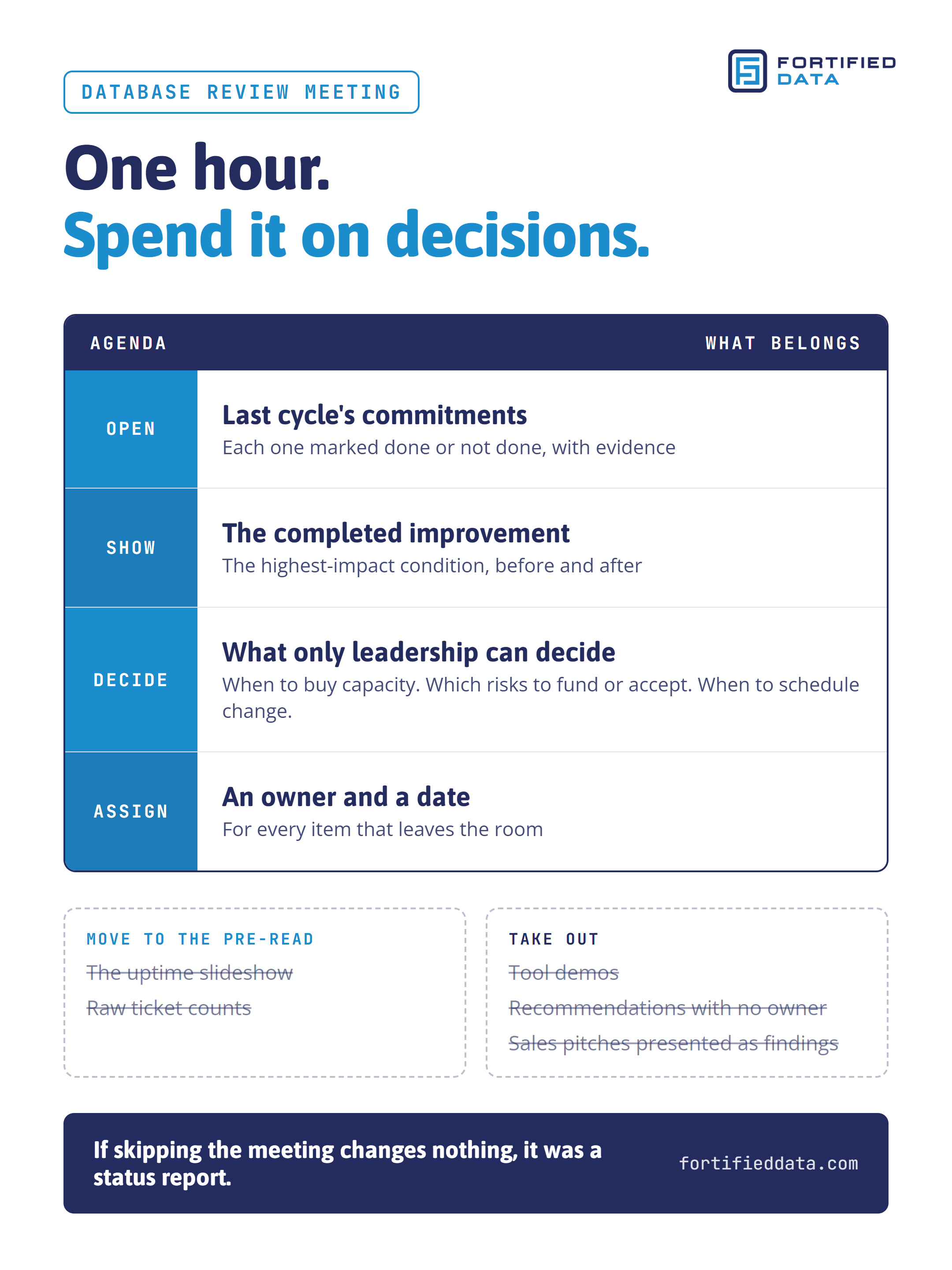
Here is a simple test for any agenda item. If the provider skipped this database review meeting, would the item change? If not, it belongs in the pre-read, and the hour belongs to decisions.
Who should be in the room, and what should they leave with?
The client side needs three seats filled: someone who owns the budget, someone who owns the business risk, and the person who owns the provider relationship. In a smaller organization, one person may hold two of those seats. The provider side needs the account owner and the people who did the work.
Leadership is there to make the decisions only leadership can make. The first is when to buy capacity, based on how many months of runway the trend shows. The second is which risks to fund now and which to accept for another cycle, in writing. The third is when to schedule changes around the business calendar, such as month-end close or open enrollment.
Every item should leave the room with an owner and a date. An action without both is a hope, and it will show up again on the next cycle's agenda. The plan itself needs an owner on the provider side between reviews, so work moves between meetings rather than only at them.
Who presents matters as much as who attends. Each Fortified Data managed services client is assigned to a POD, a dedicated DBA team that shares documentation and knowledge of the environment, supported by a Strategic Account Manager. The people explaining a finding are the people who worked it.
What should a proactive database improvement plan be worth after a year?
Most managed services engagements reach a plateau. The environment is stable, the reviews are polite, and year three looks a lot like year one. That is the operational reality a structured plan exists to prevent. Our homepage puts it in two sentences: "Anyone can keep your databases running. We commit to improving them." The commitment is what you should hold a provider to, cycle after cycle, with evidence.
A proactive database improvement plan, reviewed properly, should show up in four places after a year, each with a measure you can track:
- Cost avoidance: Conditions fixed early never became outages, and emergency projects never needed staffing. Each one is documented, so you can see what was avoided. Measure it by the conditions remediated and the outage, missed window, or emergency purchase each one prevented.
- Cost control: Capacity is purchased when the trend shows the need, not when a drive fills on a Saturday. Spend stays predictable, for less than the fully loaded cost of recruiting and retaining an internal team. Measure it by months of capacity runway, reviewed every cycle, and the unplanned purchases that never happened.
- Security and stability: Data security findings close with evidence an auditor can read. Configurations stay consistent, and issues are resolved before users notice them. Measure it by security findings closed with evidence and by configuration drift against the onboarding baseline.
- Continuous optimization: Month twelve is measurably better than month one. Queries hold their speed as data grows, recurring alerts drop off, and next year's plan is already written. Measure it by query run times and recurring alert counts against the onboarding baseline, cycle over cycle.
If a provider cannot show you what it fixed last cycle, the status report is all you are buying.
The questions to bring to your next review
Six questions separate a review that produces decisions from one that fills an hour. Take these to your next one:
- What decision do you need from us at this review?
- What did you commit to last cycle, and can we see each item marked done or not done against the baseline?
- What was the highest-impact condition you fixed this cycle, and can we see the before and after?
- Which agenda items can move to a pre-read, so the hour is spent on decisions?
- Who on your side owns the plan between reviews, and does every decision leave with an owner and a date?
- What has a year of the strategic improvement plan been worth to the business, measured against the onboarding baseline?
Then pull up the agenda from your last review. How much of that hour would survive these six questions?
Want a second opinion? Send us the agenda from your last review. A Fortified Data specialist will mark it up against these six questions and show you what a decision-focused hour looks like. To get started, talk with our team.