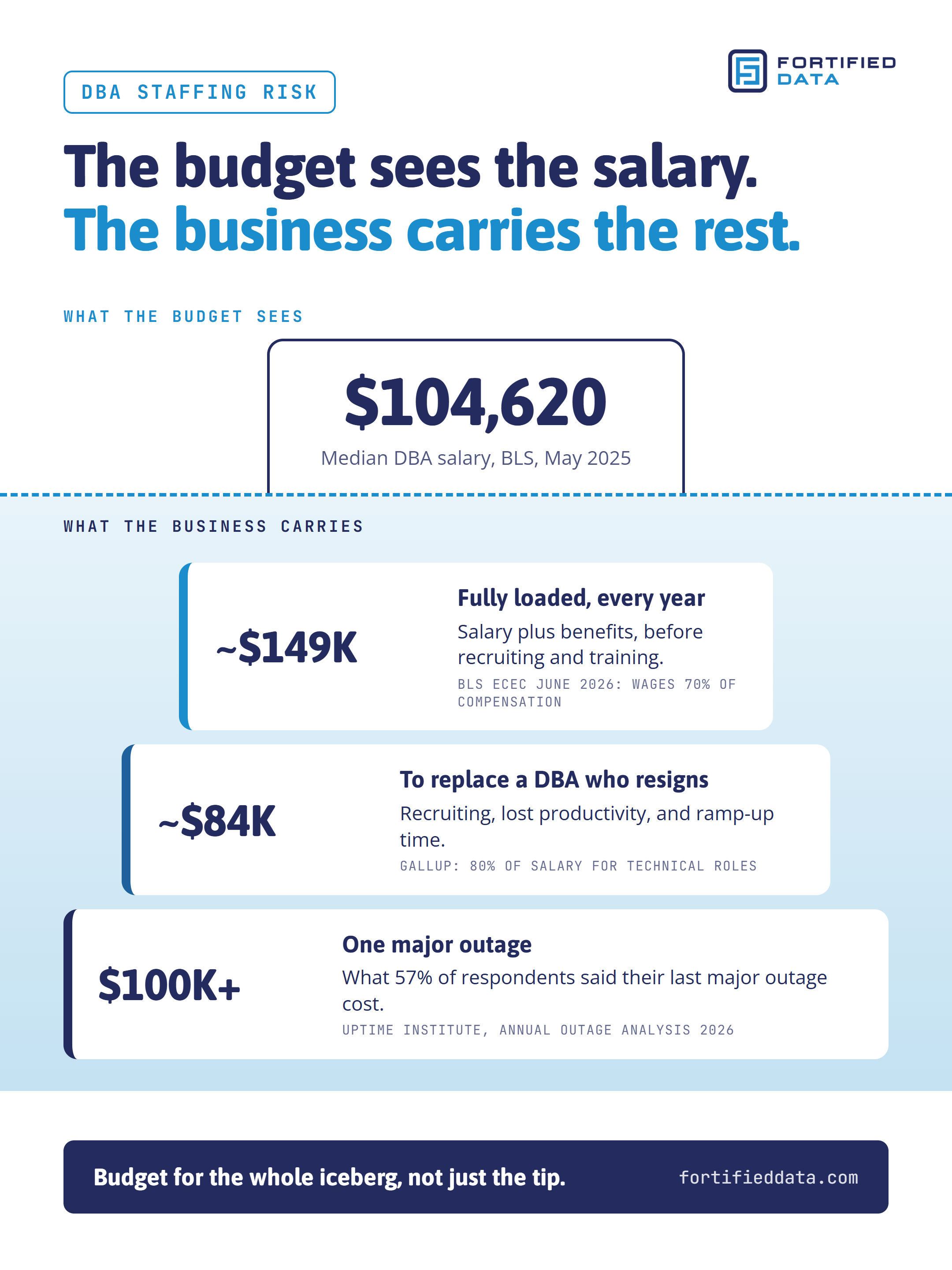
Most finance leaders would not accept a single supplier for a revenue-critical input. Yet many accept exactly that arrangement for the database, as long as the supplier is an employee. Uptime Institute's 2026 Annual Outage Analysis found that 57% of respondents said their most recent major outage cost more than $100,000, and one in five put the cost above $1 million. The cost of a single point of failure DBA never appears on a budget line. It sits off the books as risk until the day it becomes an expense.
The approved headcount is one salary. The exposure is larger: hours nobody covers, a resignation that takes the environment's history with it, and outages that run longer because the one person who knows the fix is unreachable. None of this is a criticism of the DBA. Even a high performing DBA is still one person. This is a structural problem, and it deserves the same CFO's framing you would give any other concentration risk. Here are six questions to run the numbers.
What does one DBA actually cost, fully loaded?
Start with the number most comparisons use, then finish it. The Bureau of Labor Statistics puts the median annual wage for database administrators at $104,620 as of May 2025. Database architects run $139,500. That is the salary. It is not the cost.
BLS Employer Costs for Employee Compensation data for June 2026 shows wages and salaries at 70.0% of private-industry compensation, with benefits making up the other 30.0%. Apply that ratio and the fully loaded DBA cost at the median is about $149,000 a year, before recruiting fees, training, tooling, and certifications. Your market may run higher. Either way, the real number starts well above the offer letter.
Ask your team: what is our fully loaded cost per DBA, including benefits, training, and the recruiting cost to replace them? A weak answer is the base salary.
How many hours a year is your database actually covered?
A year has 8,760 hours. A full-time employee works about 2,080 of them before vacation, holidays, and sick days. After time off, one DBA is on duty for roughly 1,900 hours, or about a fifth of the year. The database runs the other four-fifths with nobody on the clock.
On call is not the same as on duty. It means response depends on one person seeing the page, waking up, and being in a position to act. That arrangement carries its own cost. A DBA who carries every night and weekend alone is a retention risk, which feeds straight into the next two questions. Real 24/7 database coverage means someone is already working when the alert fires.
At Fortified Data, a dedicated after-hours team works a scheduled shift rather than waiting on call, so the engineer is already working when an issue comes in at 2 a.m. The team is 100% onshore and covers 24/7 x 365, with no hand-off to an offshore team.
Ask: who is watching the database at 3 a.m. on a holiday weekend, and how long before they are actually working the problem? A weak answer is "our DBA gets the alert on their phone."
What happens to database downtime cost when your DBA is unreachable?
Database downtime cost comes down to two things: how often incidents happen and how long they last. A single DBA mostly affects the second. The system failure itself may be unavoidable. The hours between the alert and the fix are where concentration risk reaches the income statement.
Uptime Institute's figures give a useful floor: 57% of respondents said their most recent major outage cost more than $100,000. ITIC's 2024 survey puts an hour of downtime above $300,000 for over 90% of mid-size and large enterprises. Small businesses and companies with a smaller SQL Server environment should treat that as a ceiling rather than a benchmark. You do not need a cost calculator to estimate your own figure. Start with revenue per hour, staff idled, and contractual penalties. Then add the indirect costs: lost productivity, customer trust, and the customer churn that follows an outage on a critical system.
Minimizing downtime is the first return on coverage. Every Fortified Data tier includes around-the-clock monitoring and alerting, so issues are caught and worked before users report them, and unplanned downtime gets shorter when it does happen.
Ask: in our last database incident, how long was it between the first alert and the first person working the problem? A weak answer is "we don't track that."
What is the real cost of replacing a DBA who resigns?
Gallup estimates that replacing a professional in a technical role costs about 80% of annual salary. At the BLS median, that is roughly $84,000 in recruiting, lost productivity, and ramp-up time. BLS projects about 7,300 openings a year for database administrators and architects nationally, so the pool of qualified candidates at any given moment is not large.
The larger cost does not show up in the replacement estimate. Finance teams call this key person risk. A single DBA carries the undocumented history of the environment: why a job runs at midnight, which server the finance application depends on, whether the backup system has been restore-tested recently. When that knowledge leaves, the exposure is not only downtime but data loss. Uptime Institute reports that failure to follow established procedures remains the leading driver of outages caused by human error. A procedure that lives in one person's head cannot be followed by anyone else.
Fortified Data assigns each managed services client to a POD, a dedicated DBA team that shares documentation and knowledge of the environment, supported by a Strategic Account Manager. Structured onboarding, completed before go-live, reviews architecture, server health, configuration, capacity, and disaster recovery readiness, then documents agreed performance goals and monitoring baselines. No single departure takes the environment's history with it.
Ask: if our DBA resigned tomorrow, what documentation would the next person inherit? A weak answer is "they would figure it out."
How should a CFO put a number on DBA staffing risk?
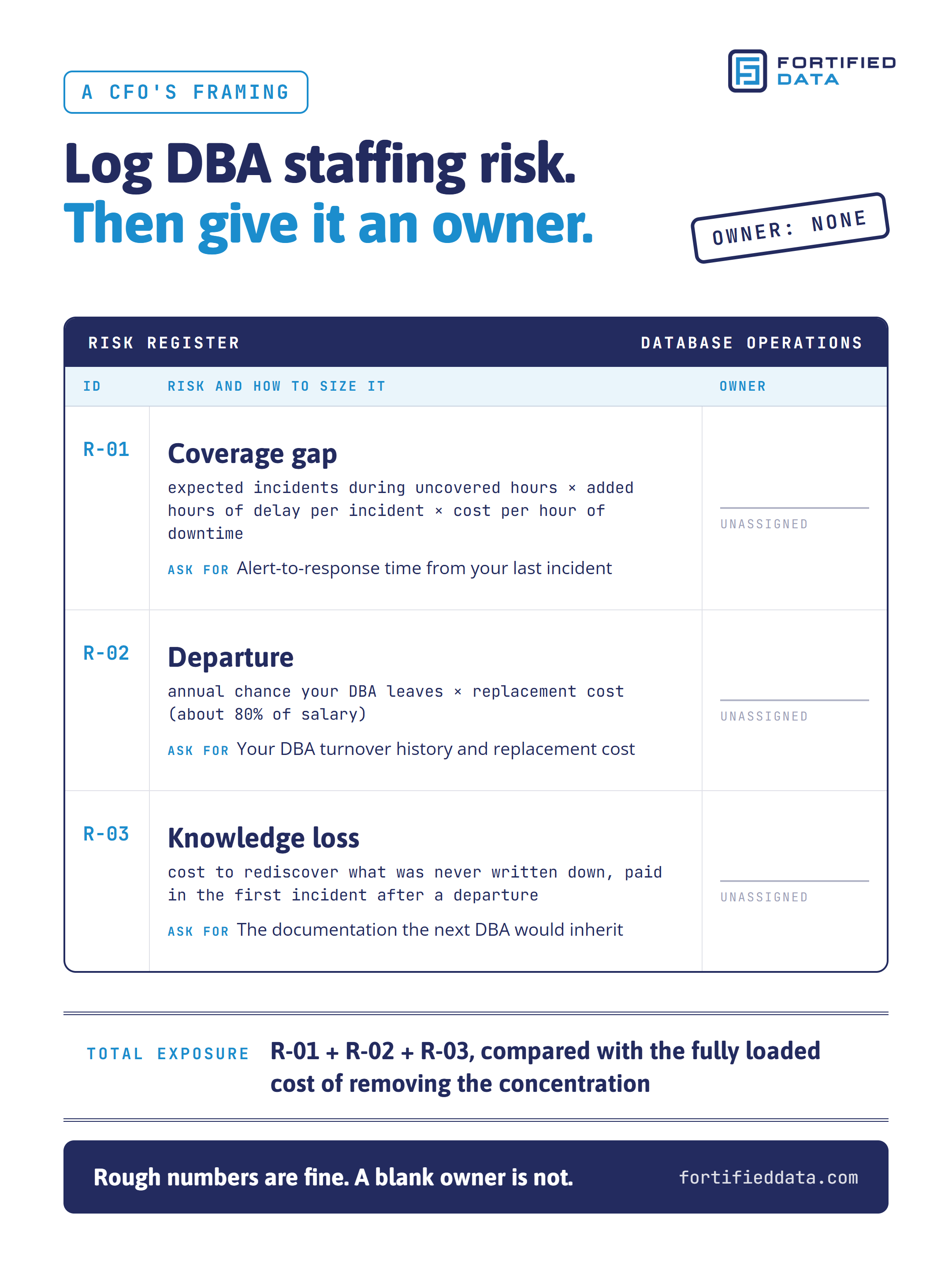
Treat DBA staffing risk the way you would treat any single point of failure (SPOF) on the risk register. It breaks into three lines, and your team can estimate each one.
The first is the coverage gap. Take the expected number of incidents during hours without on-duty coverage, the added hours of delay each one carries, and the cost of each hour of downtime. The second is departure. Take the chance your DBA leaves in a given year and multiply it by the replacement cost, which starts near 80% of salary. The third is knowledge loss. This is the cost of rediscovering what was never written down, and it is usually paid during the first incident after the departure.
Add the three lines and compare the total to the fully loaded cost of removing the concentration. The numbers do not need to be precise to be useful. In the real world, the exercise tends to show two things: the exposure is real, and nobody owns it.
Ask: is DBA staffing risk on our risk register, and who owns it? A weak answer treats it as an HR matter rather than an operating risk.
What should a lower-risk database staffing model deliver?
Removing the single point of failure is not the goal by itself. The goal is what the business gets once the risk is gone. Measure any alternative, whether a second hire, a partner, or a mix of both, against these outcomes.
- Cost avoidance: outages that never happen and emergency projects that never need staffing, because someone is always working the environment.
- Cost control: predictable operating costs in place of recruiting, training, and retaining a full internal team, with no surprise replacement costs.
- Security and stability: a patched, consistently configured environment, documented well enough that any member of the team can operate it.
- Scalable performance: capacity planning that stays ahead of growth, so the environment is never limited by one person's bandwidth.
- Continuous optimization: month twelve measurably better than month one, with fewer recurring alerts and a documented roadmap.
For Select and Signature clients after go-live, Fortified Data's Strategic Improvement Plan covers index strategy, performance, capacity, and data security. Each review cycle, the team remediates the highest-impact condition identified through telemetry and that plan, so account reviews track completed improvements, not just system status.
A fair look at database total cost of ownership sets the fully loaded cost of the coverage you need against the service fee, not one salary against it. On that basis, a dedicated managed services team delivers round-the-clock coverage for less than the fully loaded cost of recruiting and retaining an internal team to do the same. An internal DBA and outside coverage are not mutually exclusive, either. Taking operational work off an internal DBA frees that person for modernization and other strategic work. For a longer look at that trade-off, see in-house vs. managed service provider and what database management really costs.
Ask a provider: who on your team knows our environment, and what happens when that person is out? A weak answer is "you will have a dedicated resource." One named person on the provider's side is the same single point of failure with a different employer.
If a provider cannot show you these outcomes from current clients, the dashboard is all you are buying.
The six questions to take into your next staffing review
The cost of a single point of failure DBA is real whether or not it appears in the budget. Before the next headcount or renewal decision, put these questions to your team or your provider:
- What does one DBA actually cost us, fully loaded?
- How many hours a year is our database covered by someone on duty?
- What happens to our database downtime cost when our DBA is unreachable?
- What would it cost to replace our DBA, and what would the next person inherit?
- Is DBA staffing risk on our risk register, with a number and an owner?
- What should a lower-risk staffing model deliver, and can the provider show it from current clients?
If you want to run these numbers against your own environment, talk with our team.
Sources
- Uptime Institute, Annual Outage Analysis 2026 (press release, May 13, 2026)
- U.S. Bureau of Labor Statistics, Occupational Outlook Handbook, Database Administrators and Architects (May 2025 wage data)
- U.S. Bureau of Labor Statistics, Employer Costs for Employee Compensation, June 2026 (released September 9, 2026)
- Gallup, "42% of Employee Turnover Is Preventable but Often Ignored"
- ITIC, 2024 Hourly Cost of Downtime Report