
Omdia forecasts roughly 10% growth for managed services in 2026, and its MSP Trends and Predictions 2026 report says the providers who outpace that figure will be the focused, differentiated ones. Many a managed service provider (MSP) is already acting on it: expanding into security, compliance, and advisory work, and partnering with specialists where depth counts. For a company that runs a SQL Server estate, this is a healthy development. It also reshapes how to vet a managed database services provider. The useful question is no longer who lists database services. It is who brings genuine specialist depth to them.
Below are the questions that tell specialist depth apart from a line on a service menu, along with what a strong answer sounds like.
What does the msp market 2026 shift mean for database buyers?
Depth is becoming the dividing line. According to Omdia, per-user and helpdesk services have turned into commodities, while growth is concentrating in areas where clients want hands-on operational skill, not just vendor certifications. Providers are answering by doubling down on their strengths and partnering for everything else.
Database operations sit firmly in the specialist column. On a good day the work looks routine. On a bad day, the gap between a generalist and a database specialist shows up as hours of downtime, a restore that misses its recovery point, and data loss the business has to absorb.
The services offered on most provider websites read alike, so the buyer’s task this year is to test for depth directly. Ask: how many people on your team focus on databases full time, and how many years has that practice been running? Look for an answer with numbers and names. Be cautious of “we can support that” with nothing to back it up. For reference, Fortified Data’s database practice has supported mission-critical healthcare, financial services, and retail environments for more than 20 years, with a 100% onshore team of experienced DBAs and principal consultants.
Why is specialist database talent so hard to build in-house?
Hiring is tight on both sides of the table. Kaseya’s 2026 State of the MSP Report, drawn from more than 1,000 providers, shows the share of MSPs reporting trouble hiring skilled technicians climbing from 9% to 16% in a single year. If service providers are feeling that, a company with 10 SQL Server instances and no dedicated database team will feel it more.
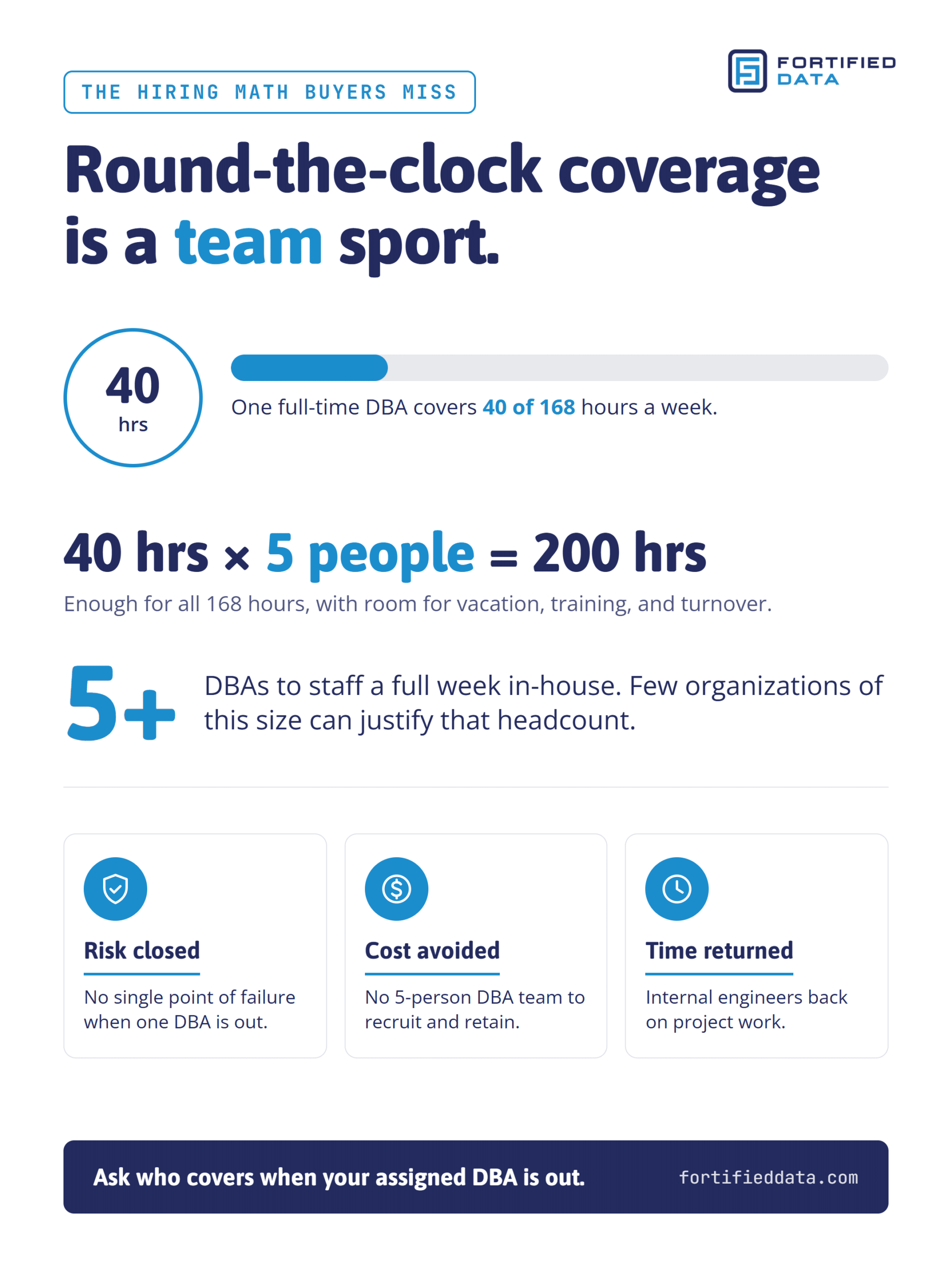
Coverage math makes it concrete. A week holds 168 hours, and one full-time DBA works roughly 40 of them before vacation, training, or turnover. Staffing the whole week internally takes at least 5 database administrators, whether the estate runs on premises or on a cloud platform such as Azure, AWS, or Google Cloud. Few organizations of this size can justify that headcount, so one DBA ends up carrying the estate alone, and every sick day becomes a risk.
Closing that gap is the core job of a managed database services provider, and a specialist team is usually the more cost effective route. Fortified Data brings senior SQL Server specialist depth, backed by multi-platform discipline, for less than the fully loaded cost of recruiting and retaining that team internally. Your own staff get their time back, too: the people who were fielding database alerts at night can return to the projects they were hired for.
Ask a provider: how many DBAs will know my environment well enough to act without a ramp-up, and who covers when one is out? A strong answer describes a team that shares documentation and history on your systems. A weak one names a single assigned resource backed by a generic help desk. Fortified Data assigns each managed services client to a POD, a dedicated DBA team that shares knowledge of the environment, supported by a Strategic Account Manager.
How to vet a managed database services provider: who actually delivers the work?
This question reveals more than any other. Plenty of MSPs deliver excellent database results by teaming with a dedicated database specialist inside their client relationships. Fortified Data supports clients directly and through MSP and technology partners. In a partner engagement, the partner owns the broader, day-to-day relationship and its infrastructure, application, or security services, while Fortified Data delivers the database work. Clients get the full breadth of their MSP with the depth of a database specialist.
What counts is that a specialist is the one doing the work. For a mixed estate, that matters even more, because deep SQL Server knowledge does not carry over automatically to PostgreSQL or Oracle.
Ask: which engineers specialize in each platform we run, and how long have they worked on it? The answer should be specific. At Fortified Data, every platform we support (SQL Server, PostgreSQL, Oracle, and MySQL) has named specialists assigned, so a mixed environment gets real depth on each system instead of one generalist covering all four.
What does operational discipline look like at 3 a.m. on a Sunday?
Most organizations cannot sustain operational discipline on their own, and the gap shows most clearly after hours. Omdia points out that cyber insurers increasingly expect baseline controls such as dependable backups and privileged account monitoring, with some refusing coverage when those are missing. Keeping controls like these intact every night of the year depends on staffing as much as on technology.
Onshore 24/7 DBA support is only as good as the people on shift and the way service levels define response times. Ask: overnight and on weekends, is your engineer on shift or on call, and what counts as a response in your agreement? A strong answer defines response as a person working the problem. A weak one starts the clock at an automated acknowledgment, which can satisfy the contract while your production database sits idle.
Fortified Data staffs a dedicated after-hours team that works a scheduled shift rather than waiting on call, so the engineer is already working when an issue comes in. Coverage is 100% onshore, 24/7 x 365, with no hand-off to an offshore team. Every tier includes around-the-clock monitoring and alerting. On our Select and Signature tiers, Core Support gives clients a direct line to a Level 2 DBA, bypassing triage, backed by a 15-minute response commitment.
Does the partnership get better over time?
Here the difference between specialists and generalists is sharpest. Keeping an estate running is table stakes. A specialist partner should leave it in better shape with every review cycle: quicker queries, fewer repeat alerts, cleaner configurations, and a written plan for what comes next.
That work begins before coverage starts. Fortified Data runs a structured onboarding ahead of go-live that reviews architecture, server health, configuration, capacity, and disaster recovery readiness, then documents agreed performance goals and monitoring baselines. After go-live, Select and Signature clients receive a Strategic Improvement Plan covering index strategy, performance, capacity, and data security. Each review cycle, our team remediates the highest-impact condition identified through telemetry and that plan, which turns account reviews into strategic planning that tracks completed improvements, not just system status.
A documented, well-tuned estate also pays off beyond day-to-day stability. It is the data foundation that makes analytics, modernization, and AI initiatives workable, whether the next step is a cloud migration, a move between public clouds, or a new reporting platform. Ask a provider: what measurably improved over the past year for a client like us? A strong answer shows before and after. A weak one hands you an uptime report, which confirms nothing broke but not that anything improved.
What should choosing a database managed services partner get you?
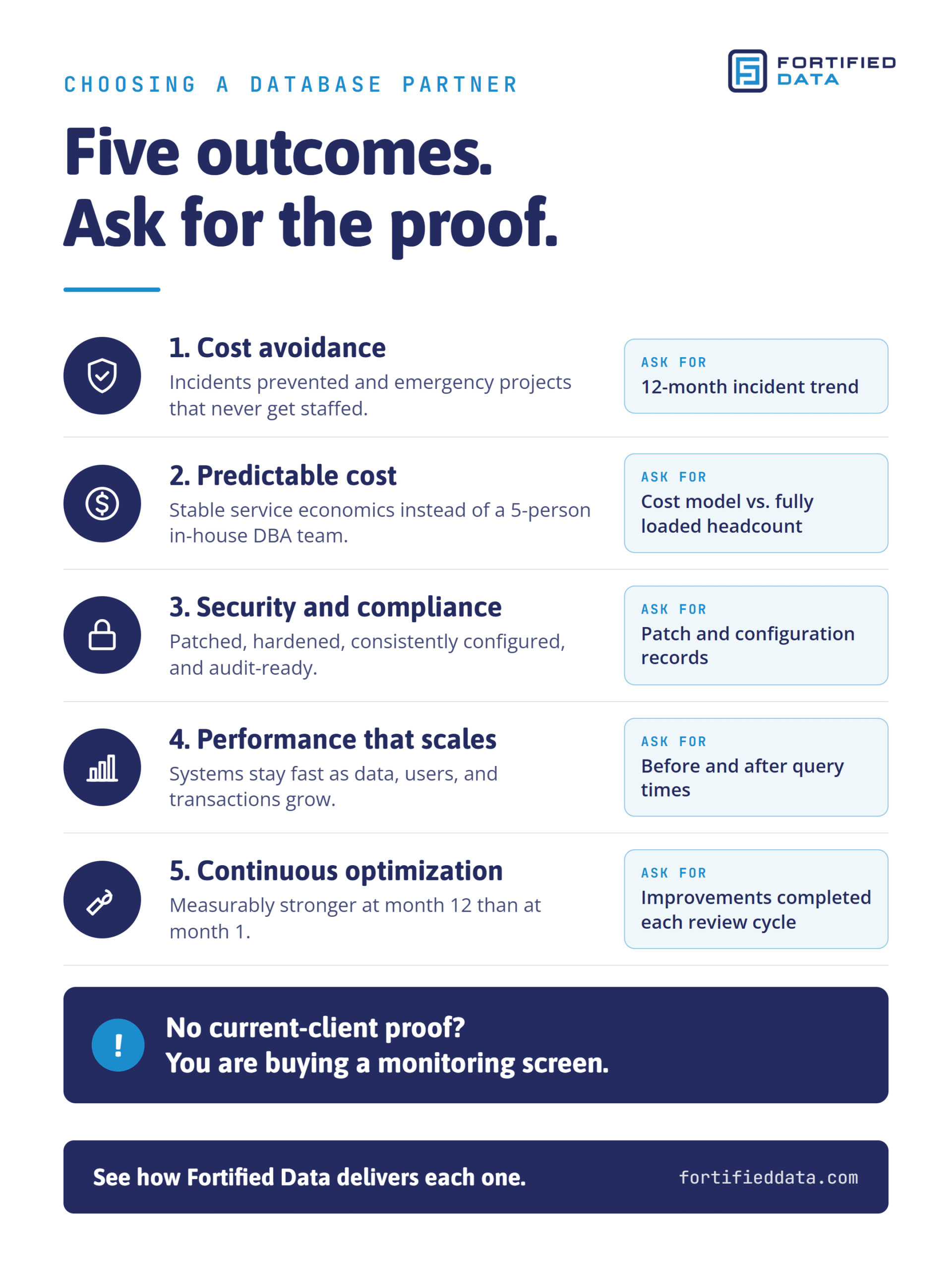
Ticket counts and monitoring screens measure effort. A CFO or CIO should be buying results. When choosing a database managed services partner, expect evidence of these:
- Cost avoidance: Incidents prevented and emergency projects that never have to be staffed. New capacity is bought when the data calls for it.
- Predictable cost: Accountable, stable service economics instead of recruiting, training, and retaining a full internal DBA team, with licensing and cloud consumption matched to real usage.
- Security and compliance: A patched, hardened, consistently configured environment, with problems resolved before users notice and audit-ready evidence on hand for insurers and regulators.
- Performance that scales: Capacity planning and tuning that keep high-volume systems at optimal performance as data, users, and transactions grow.
- Continuous optimization: An estate that is measurably stronger at month 12 than at month 1, guided by a documented roadmap.
If a provider cannot point to these results with current clients, what you are buying is a monitoring screen. To see how Fortified Data delivers high performance on each of them, read our overview of managed database services.
The questions that find specialist depth
The msp market 2026 story is not about providers doing less. It is about a market that rewards providers who do specific work very well. Knowing how to vet a managed database services provider comes down to six questions:
- How many people work on databases full time, and how long has the practice existed?
- How many DBAs will know your environment, and who covers when one is out?
- Who specializes in each platform you run?
- After hours, is the engineer on shift or on call, and what counts as a response?
- What measurably improved for a client like you in the past year?
- Can the provider show cost avoidance, predictable cost, security and compliance, performance, and continuous optimization from current clients?
If you would like to see how Fortified Data answers these six questions for your estate, talk with our team.
Sources
- Omdia, MSP Trends and Predictions 2026 (Robin Ody, January 2026), as summarized by Acronis: https://www.acronis.com/en/blog/posts/msp-trends-2026-creating-opportunities-in-a-difficult-market/
- Kaseya, 2026 State of the MSP Report (press release, April 14, 2026): https://www.kaseya.com/press-release/ai-emerges-as-the-key-to-scaling-msp-operations-as-growth-gets-harder/